
Riyadh to London,
August - September 1981
Beware: All prices and administrative details are very old, and may have
changed significantly since then. Most prices are quoted in UK £.
|
|
The first half of our route, from Riyadh to Yugoslavia through Saudia Arabia, Jordan, Syria, Turkey and Bulgaria. |
Saudi Arabia
Sunday 9th August. Riyadh, 7.45 am. 4764 miles on the speedometer.
Drove all day towards Medina, stopping for lunch in Buraydah. Camped on the desert about 50 km before Medina - we had no room in the car for real camping equipment so our 'camp' was the car rugs laid on the ground.
Monday. 50km from Medina, 6.30 am. 5317m.
Drove on past Medina and through Khaybar and turned off to Al Ula and Medain
Saleh. Attempting to go to Medain Saleh in a normal saloon car is not recommended
- the luggage rack shook loose on the rough ground, we took the wrong track
and got lost, and got stuck in the sand. We had been following a family of
Saudis in a Suburban who we gathered were also going to the tombs at Medain
Saleh, but it transpired that they were strangers to the area and were also
lost. However, they were extremely friendly and helped to push us out of
the sand, and we all eventually found the tombs. The Saudis: Abdullah, his
father, uncle, sons and cousins, were from Jeddah and were on a leisurely
sightseeing holiday, having driven all the way up the coast to the Jordan
border then inland back south again. Abdullah had made several previous
trips to other parts of Saudi Arabia, and this struck us as unusual as
we had not met any Saudis that interested in seeing their own country before.
We all drove back through Al Ula and camped after about 50km.

|

|
| The Nabatean tombs at Medain Saleh. | ... the Nabateans 'practiced' here before they moved to Petra. |
Tuesday. 50km from Al Ula. 6.30 am. 5664m.
We had breakfast with Abdullah and family and then drove on, parting at
the main road where they turned towards Medina and we went on to Tayma
and Tabuk, which is quite a big place but disappointing - we couldn't find
the souk or any item of interest except the Hejaz railway station, so we
carried on. There is a hotel that looked alright on the Jordan road going
out of Tabuk, but we didn't stop. About 53 km out of Tabuk we turned off
the main road that leads to Jordan, crossed the Hejaz railway (defunct for
60 years) on a large modern bridge! and took the road towards Aqaba in Jordan.
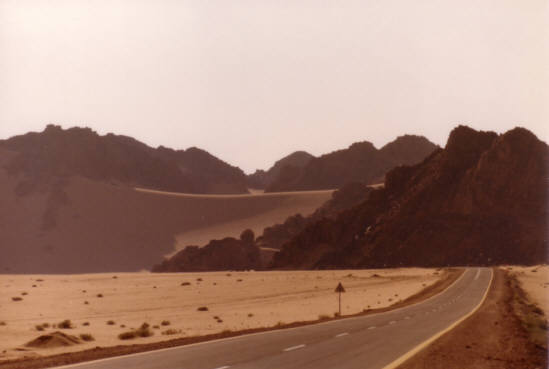
This turned out to he a very good road and as it crossed the Hejaz mountains
the rock formations were fantastic, followed by views of the Red Sea, Sinai,
Elat and Jordan as it dropped down to the coast and the Saudi - Jordan border.
|
The road through the Hejaz mountains. |
Jordan
We went through the Saudi side with no trouble, although we were quite thoroughly searched for duplicate registration plates and documents after they had taken away the originals. We did not get into Jordan so easily, however, because the customs man had gone home. The procedure is that the car is expected to enter the country with no plates or documentation. The car is given a letter of permission to be in Jordan at the customs head office in Aqaba (at no charge) but this can only be done in working hours - we arrived in the evening so we had to camp at the border (we should have stayed in Tabuk). If we had arrived on Thursday afternoon we would presumably have been stuck until Saturday morning. We also found that our Jordan visas had expired, but they happily issued us new ones on the spot at 3 Dinars each.
Wednesday. Jordan Border, 6.30 am. 6195m.
The customs man took us to head office to get permission for the car. This
took several hours, including the customs man being denied access to the
port where the office was, and having to go to the police to obtain permission
to get to his own office. When this was finally finished we went to the
Holiday Inn - a bath! a toilet! such undreamed-of luxury! We swam in the
clear cool sea, and had a proper meal. Then we drove out of the hotel straight
into a radar speed trap and got fined £7 on the spot! This was in
fact our only brush with the law during the whole journey, but it didn't
seem like a very good start. In the afternoon we drove to Wadi Rum, of
Lawrence fame - more incredible Hejaz rock formations and a picturesque
little fort. Had a decent meal and retired to a real bed.

|
The view from the fort in Wadi Rum. |
Thursday. Holiday Inn, Aqaba, 9.45 am. 6312m.
Drove to Petra. Everything seems so close together here after the vast
distances in Saudi Arabia. Stayed at the Government Rest House - booked
the previous night, luckily, as it was full. Four people in a Volkswagen
labelled 'Sana'a to London' were turned away. Visited Petra - magnificent,
but it's sad to be back to tipping, backsheesh, guides etc.

|

|
| The amazing ruins of Petra, created by the Nabateans... | ... who previously lived at Medain Saleh, see above. |
Friday. Petra, Jordan, 7.45 am. 6395m.
Took a wrong turning and ended up in Ma'an so we had a look at the Hejaz
railway station, also of Lawrence fame. Drove to Kerak (Crusader castle)
and Madaba (mosaics) along the 'Kings Highway' which winds through the mountains
overlooking the Jordan valley and the Dead Sea, then to Amman and stayed
in a hotel overlooking the Roman Amphitheatre.

|

|
| Inside the Crusader castle at Kerak. | 6th century map of Palestine - part of the mosaics at Madaba. |
Saturday. Amman, 11.00 am. 6633 m.
Had a look around Amman, then drove to the Dead Sea for a float.
Sunday. Amman, 8.30 am. 6716m.
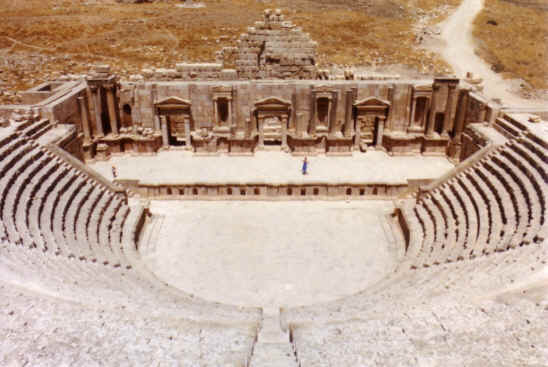
Drove to Jerash, an extremely well preserved Roman town. While we were
looking round we were filmed by a Jordanian TV film crew doing a documentary
on Jordanian antiquities, and as we ooh-ed and ah-ed and pointed to bits
of the ruins, one of the crew acted as a guide and chatted away in incomprehensible
pidgin English as if he was showing us around. Luckily it was not a sound
recording because Jamie kept yelling from off-screen that he wanted to
go to the toilet! Then we went on to the border.
|

|
| The magnificent Roman ruins at Jerash. | ... but even magnificent Roman ruins can be just too exhausting. |
Syria
The Jordan-Syria border is a very trying experience. The whole thing hinges on whether the Syrian customs authorities will accept your car plates and registration documents as valid - they don't have to be originals, but the plates must be good quality metal ones, no cardboard replicas, and our registration book was a photocopy cut to the right shape and certified genuine by the British Consul in Riyadh. Even then, it is entirely up to the Chief of Customs - there are no rules, and if he says no, then it's no. Luckily for us he said 'yes'. Note that 'export' plates such as some countries issue do not seem to be acceptable.
(A) If your documents are not acceptable, then it will work out expensive as follows (in fact if you follow this procedure you don't have to have any plates or registration book at all and you can still presumably get back to England, but it will cost you!) When you reach the Jordanian side of the border, little boys will rush up and demand your documents - if you hand them over they will get a manifest prepared for the car for you to give to the Syrians, and they will try to charge about £50 for the privilege. They can be haggled down to about £30, but if you do it yourself it will cost less than £10 and take considerably longer! When you get to the Syrian side you have got no choice but to use an agent - you give him the manifest (again little boys will come demanding the documents before you even have a chance to get out of the car) and he will do all the paperwork. Very painless, until you have to pay about £50 which is refundable when you leave Syria, and another £80 which is not. Not all of this goes in the agent's pocket - there are dozens of different guarantees and taxes they have to pay. One of these is a convoy tax because if your car is unregistered you are only allowed to cross Syria as part of a convoy, although we were told this wouldn't apply to us as we were a family. However, you only get 72 hours max. to cross the country which doesn't leave much time for sightseeing. All of these arrangements can only be made in normal working hours.
(B) If your documents are acceptable then it is a very different picture. Put the plates on the car anywhere in Jordan - they don't seem to mind whether you've got them or not. On the Jordan side of the border, they will insist that you need the manifest anyway and that the Syrians will turn you back without it. If you are really confident about your documents ignore them, else go to A. When you get to the Syrian side, hide the Jordan manifest if you've got one, brush aside all of the little boys and attempt to follow the maze below.
l. Park the car.
2. Change some money at the bank, because they may ask to see the change slip later on - you're not supposed to bring in Syrian money.
3. Get a form at the front counter in the Customs Office and fill it in, in Arabic (get help from a bystander).
4. Get the Chief of Customs at the desk opposite the entrance to the Customs Office to write something on the form (this is where he will decide if your documents are OK or not. He will probably ask to see the plates on the car).
5. Buy a set of stamps for 25 Syrian pounds (about 10 SP = £1) at the little shed beyond the Customs Office.
6. The man in the office behind the front counter in the Customs Office has to write something on the form too.
7. Give the form, passports and stamps to the man behind the front counter in the Customs Office. He prepares the customs document and you have to pay him 25 SP as well.
8. The man in the office opposite the bank has to stamp something on the document and you pay him a few SP.
9. Drive the car up to the benches to be searched. After you have been searched and they again check that your plates and registration book are acceptable (a nasty moment - the man who checked us said no good, but then the Chief of Customs came and overruled him) he stamps something on the document and you are in. Sounds simple but it takes a long time.
10. You have to buy third party insurance at the border. You get it at the shed beyond the office opposite the main Customs Office. You can do this in any spare moment during 1 - 9!
What we actually did was to get the manifest on the Jordan side because we didn't know any better, had a terrible row with the agent when he tried to charge us £50 and after seeing everyone from the Chief of Customs down paid him US$20 in cash. On the Syrian side we almost gave up and used the agent to prepare the £50 + £80 for 72 hours' worth, but at the last minute we found the Syrian Chief of Customs who said our documents were OK. We then did 1 to 10 with a lot of help from a very friendly Syrian who was there. Whenever people offer to help you, you get very suspicious that they are after something but in fact, this chap spent a lot of time and effort for us and didn't expect anything - we gave him some packets of cigarettes and he was genuinely grateful. On both sides of the border the passport formalities are fairly straightforward, it's the car that causes the trouble.
It was dark by this time but we drove on to Damascus and started looking for a hotel. There seems to he a big gap in grades of hotel between the Sheraton style at about £50 a night and lots of fairly average style hotels at £10 - £15 a night. We had quite a long search because all the hotels seemed to be full, but eventually we found a reasonable one with one room free. A long day!
Damascus, Syria
Monday. I treated myself to a day off driving and we had a conducted
tour of Damascus in the morning and walked around in the afternoon. Damascus
is very interesting and certainly worth a visit. The old part is just how
an Arab city should be, with seething souks and very ornate mosques and
palaces. The new part has the feel of a modern captial city. In the evening
we had a very good meal at the Ali Baba restaurant, and we also had a bottle
of Syrian produced wine, which was horrible!

|

|

|

|
| The Omayyid Mosque ........... | and El Azeem Palace, Damascus. |

|

|

|
In the souks and streets of Damascus. |
Tuesday. Damascus, 8.45 am. 6847m.
Drove to Homs on quite a good road, mostly dual carriageway, and on to
Hama to see the very impressive giant water wheels. We then backtracked
to Homs and turned west, stopping at Krak des Chevaliers, another very
well preserved Crusader castle an a hilltop, and on to the coast through
Tartous to Lattaquie. This part of the coast seems industrialised and not
very attractive, and the road was terrible. We saw the first clouds since
leaving Riyadh. Had a Syrian produced bottle of beer with our meal - not
quite as bad as the wine.

|

|
| One of the giant water-wheels of Hama. | Krak des Chevaliers, another classic Crusader castle. |
Wednesday. Lattaquie on the Syrian Coast.
A day at the Meridien Hotel, sunbathing, swimming and building sand castles.
Thursday. Lattaquie, 8.45 am. 7159m.
Drove through very picturesque wooded mountains to the border. The Syrian-Turkish
border was a positive delight after the last one. We appeared to be the
only people going through, and the only holdups were because some of the
officials were away having a nap or a cup of tea or something. The Syrians
took away the document we got as we came in, stamped our passports and we
were out (we even had to open and close the barrier ourselves because there
was nobody there).
Turkey
The Turks stamped our passports, glanced briefly at the copy of the registration book, glanced at the car, wrote something about the car into my passport and we were in. No money changed hands. The only catch is that the bank at the border doesn't change travellers cheques, in fact lots of banks in Turkey don't, so you have to make it to the first big town before the banks close or you're stuck without money. We drove on towards Anakara - very slow progress after we joined the main road, with an endless stream of lorries in both directions. Turned off towards the Cappodoccia region and got to Nigde by dark. Stayed in an extremely basic hotel, but at £1.50 we weren't complaining.
Friday. Nigde, central Turkey, 8.15 am, 7476m.
Explored the Cappadoccia region around Nevsehir with underground villages,
rock-hewn churches and landscapes of weird rock formations. Most unusual
and definitely worth a visit. Stayed at a 'pension' in Avanos - very pleasant
for £2. There is also a good hotel here and a restaurant overlooking
the river where we had dinner. Unfortunately we had to retreat indoors
when it got dark as the air became full of moths, thicker than a snowstorm.

|

|

|
Cappadoccia - rock formations, 'fairy chimneys' and rock-hewn churches. |
Saturday. Avanos in Cappadoccia, central Turkey, 8.45am. 7590m.
Drove towards Ankara, staying on small roads and away from 'E5', the main lorry route. Had a short drive around Ankara then drove on. First shower of rain on the journey. Followed the 'E5' road until 200km before Istanbul, then turned off to Akcakoka on the Black Sea coast. A nice little village, with plenty of restaurants and pensions because it seems to be where Turkish people go for their holidays. Had a quick swim before it got dark. The sea is beautifully clear and completely unpolluted - we have now swum in four seas in two weeks!
Sunday. Akcakoka, Black Sea coast, 10.20 am. 7954m.
A thunderstorm blew up during the morning so we decided to move on.
Istanbul, Turkey
Drove to Istanbul through intermittent pouring rain, arriving at lunchtime. There is plenty of everything in Istanbul, including sights, shops, hotels and tourist information bureaux. The Grand Bazaar is a bit of a tourist trap - the Damascus souks were better. Everything in Turkey seemed very cheap to us, possibly because of an artificial exchange rate for Turkish liras.
Monday & Tuesday. Sightseeing and shopping in Istanbul.

|

|

|
Sights of Istanbul - Sultan Ahmet mosque and at the Topkapi Palace. |
We also went to get our Bulgarian visas, which is a bit of a nuisance because you have to queue for hours and then you can only get a transit visa for 2 days. They say you can get a tourist visa for a longer stay at the border. We shall see.
Wednesday. Istanbul, 8am, 8200m.
Bulgaria
Drove to the Bulgarian border. This seems to be a tourist road - lots of German cars, some pulling caravans all driving very fast. The border was extremely busy - very long queues of cars and people, but in fact they are very efficient and the queues move fast. No problem with the car and no payments required, except that you have to change $14 worth of 'hard' currency into Bulgarian for every day you intend to stay. No problem extending our transit visas into 5-day tourist visas. We also bought some petrol coupons which are supposed to be cheaper than buying petrol with cash, but this turned out to be a disaster because we bought far too many and then half the garages wouldn't take them. You are supposed to be able to convert them back into cash as you leave the country. We shall see.
Drove to Sofia. On the outskirts we were flagged down by a policeman, as
were several other cars - we realised they were stopping all the cars with
roof racks. The policeman wandered off to talk to someone else, and the other
drivers who all appeared to be Turkish said they were checking the Turks'
permits, and we should ignore the policeman and drive on, so we did. We stayed
in the newest, biggest and best hotel in the city at £25 a night, which
was extremely good value compared to the 'cheapies' which were grotty at
£15.

|

|
| The National Theatre, Sofia. | View from the Vitosha Hotel, Sofia. |
Thursday. Sightseeing in Sofia, Bulgaria.
There is not actually a lot to see, but there is a pleasant pedestrian-only part of the city centre to stroll in with parks, fountains, cobbled streets, etc.
Friday. Sofia, 9am. 8566m.
Yugoslavia
Drove to the Yugoslav border. The border formalities were ridiculously easy at both sides - a glance at the passports and the insurance 'green card' and that was it. However, cashing in the excess petrol coupons was a big hassle, and altogether they were more trouble than they were worth. Drove into Yugoslavia, and turned off to head for the coast. Unfortunately the road we picked turned out to be closed to foreigners further on, and we were re-directed a long way round. It started to pour with rain and we decided to stop in Kraljevo which looked like the last place for a long way big enough to have a hotel. For the first time in our journey we found a place that didn't seem to have a single nice feature. The rain had penetrated the luggage on the roof rack and a lot of our things were wet. Later that night Jamie was very ill from eating the hotel food. Altogether, this was the low spot of the holiday.
Saturday, Kraljevo, central Yugoslavia, 5.30 am. 8764m.
Drove through misty, damp mountains to Titograd (now Podgorica, Montenegro)
and to the coast. Suddenly it was warm and sunny again. Drove up the coast
past pretty bays, villages, islands, etc. to Dubrovnik and stayed in one
of the many private houses offering zimmer/camere/rooms. Dubrovnik is very
picturesque indeed.

|
The view from the B&B near Dubrovnik was spectacular ... |

|
... View of Dubrovnik from the B&B. |
Sunday. Sightseeing and sunbathing in Dubrovnik.
Monday. Dubrovnik 9.15 am. 9110m.
Drove at a leisurely pace up the coast, stopping for a sunbathe on the
way. Arrived in Split - not so attractive after Dubrovnik so we drove a
little further on to Trogir, another complete preserved mediaeval town on
a little island, and stayed in another guest house.

|

|
| Sveti Stefan, a picturesque village on the Adriatic coast. | Trogir, Yugoslavia. |
Tuesday. Trogir, Adriatic coast. 8.45 am. 9275m.
Drove up the coast. No sun, so we didn't stop to sunbathe.
Italy
Reached and crossed the Italian frontier - very straightforward. Stayed in a small hotel in the centre of Trieste.
Wednesday, Trieste, Italy, 9.30 am. 9541m.
Drove towards Milan. Detoured to Lake d'Iseo intending to stay in a picturesque village on an island in the lake, but it was very misty and overcast so we went on to Milan instead.
Thursday. Milan, 9.30 am. 9832m.
Pouring with rain, so we decided to carry on rather than shop, which was the original intention. Drove to Geneva.
Switzerland
Friday. Geneva, Switzerland, 9.am. 10,079m.
Had a look round the old town. Tried to see the fountain but it was switched
off! Drove into France.
France
We seemed to have been rushing it since northern Yugoslavia because of the bad weather, so as the weather had improved we decided to meander through France rather than head straight for Paris. We regretted not spending an extra day each in Damascus and Dubrovnik. We were also influenced by the fact that if we want to avoid paying import duty on the car in England we cannot cross the channel before Monday. Note that for a car to be eligible into the UK duty-free then the car and its owner must have been outside the UK for more than a year. In other words, if you spend your leaves at home, that time doesn't count towards the car's year. Drove at a leisurely pace through the mountains to Dijon.
Saturday, Dijon, France, 11.30am. 10,208m.
Drove around the wine producing areas around Nuits - St Georges and Beaune. Drove towards Reims and stopped in Chalons-Sur-Marne.
Sunday. Chalons-sur-Marne, 10.45 am. 10,418m.
Drove to Reims and had a look round. Drove a roundabout way to Dunkirk.

|
Inside Reims Cathedral. |
Monday. At leisure in Dunkirk and Calais.
Tuesday. Dunkirk, 6am. 10,758m.
U.K.
Drove to Calais and got the ferry to Dover. To import the car you drive into the 'red' channel and declare that that's what you want to do. If you are claiming exemption from duty you have to fill in a declaration to that effect, and they check your dates fairly thoroughly. See note above about being outside the UK for more than a year. In our case they checked my passport and all our documents, especially my record of cheques that I had cashed, to see if there were any indications of visits to England other than those you have stated. You don't have to pay anything, but before you are allowed in you do have to produce proof of third party insurance. I thought my 'green card' would do but this is not the case - because we are returning residents rather than visitors to the UK, the green card is not valid at all. We therefore had no choice but to go to the nearby AA office and take out a temporary importers insurance at a ripoff £36 for 3 days! You do not have to re-register the vehicle on the spot. The customs people give you a document stating that you have just imported the car, and you are supposed to register it as soon as possible, meaning that you are allowed to drive home and then either your next journey must be to the nearest vehicle licencing office or you must post off the documents the same day. The vehicle licencing people tell you which number you've been allocated and you then have to get a garage to make the plates. The procedure is explained on form V55/5 and its associated booklet, available from any Post Office.
Drove to London.
Tuesday 8th September, Victoria, London. 12.30. 10,864 miles. Total
journey 6,100 miles (9,760 km).
Afterthoughts
We didn't meet any bandits, and saw no signs of wars or riots. We didn't
pay any bribes, suffered very few rip-offs, and a predictable amount of
bureaucracy. We met a lot of very friendly people and saw a lot of interesting
sights. All the way the impression was of normal people going about their
normal business, not the looting and pillaging we had been led to expect.
We were reasonably cautious - we didn't travel at night, we didn't camp out
after we left Saudi, and we carried as little as possible of value, the
exception being cameras and travellers cheques. All the way the car looked
pretty dirty and scruffy and generally not worth robbing, and most of the
way we were the same.
The key points in the journey were getting the plates and registration book out of Saudi and getting the car into Syria. In retrospect everything else was straightforward, although it didn't always seem so at the time.
We thoroughly enjoyed the journey, and would recommend it to anyone who
is interested in seeing a bit more of the Middle East. If you want to
get to Europe as quickly as possible it may not be the best way to go,
as you would telescope all the frustrating bits together. I think at least
four weeks is needed to make an enjoyable holiday of it - apart from anything
else, it's a long drive!
Forethoughts
This is what we did before we left Riyadh and how relevant it turned out to be:
- Got Saudi exit/reentry visas. It does not appear to be the case as was rumoured that you can only export a car on an exit-only visa.
- Got Jordan visas. This turned out to be a waste of time - visas are issued at the border.
- Got Syrian visas. This is important.
- You do not need visas for Turkey or Yugoslavia if you have a British passport. You have to get the Bulgarian visa on the way because there is no embassy in Saudi Arabia.
- We had up to date vaccination certificates for Cholera, Smallpox and Yellow Fever, but we were never asked to show them.
- As well as British and Saudi driving licences I obtained an international licence from the AA in England. These are also obtainable in Riyadh at the Kuwait AA or Jordanian AA, but are more expensive.
- Took a photocopy of the car registration book and had it certified by the British Consul in Riyadh. This cost 25 Riyals (£4) which was exceptionally good value as it saved us £80 in Syria!
* Note: This is worth doing even if you are shipping the car home as it simplifies the registration procedure in the UK.
- Obtained a duplicate set of registration plates.
- We enquiried whether it is possible to register the car in the UK prior to its arrival, but it is not.
- We did not get a carnet de passage. One is not required.
- We extended our Saudi motor insurance to cover Jordan, Syria, and a 'green card' for Europe including Turkey.
- Took out a medical insurance policy from Norwich Winterthur in Riyadh.
- Obtained a 'no objection certificate' from the Nasiriyah Traffic Police, with the assistance of the work Passport and Visa office.
- Obtained 'permission to export' from the Murabba Traffic Police, again with the assistance of the work Passport and Visa office. Once you have this, you have just five days to get the car out - as Jordan is quite a long way away, you can't hang about.
- Obtained permission to visit Medain Saleh from the Museum in Riyadh. This is still required at the police posts at each side of Al Ula and in Medain Saleh itself, but you no longer have to report to the Emir's office in Al Ula.
- Acting on good advice from the Motor Pool we bought various spare parts
for the car from the Honda agents and the car souk. Note that legally
you must have two warning triangles in Turkey. In the event, we had absolutely
no trouble with the car at all, not even a puncture. We also took a jerry
can of water for emergencies, which was much appreciated for early morning
washes when camping out. We did not take any spare petrol - there are plenty
of petrol stations all the way, although you don't seem to find other
facilities like air lines until Turkey.

|
Hazard on the road in Saudi Arabia. |
John, Sheila and Jamie Squier.